
What Is Occupational Therapy For Kids?
Are you a caregiver of a child with an intellectual or developmental disability (IDD)? Or simply a parent or guardian looking to support your child with their daily routines? You may be wondering how and from whom you can seek help. Occupational therapy (OT) may be the answer for you.
This article will highlight:
- What OT is
- How OT can be helpful for children with a variety of needs
Looking for more caregiving resources? Check if you have free access to Trualta.
What Is Occupational Therapy?
Occupational therapy (OT) is a type of healthcare service that supports a person’s function in daily activities.
The term “occupation” refers to any activity or daily task. Sometimes, certain challenges get in the way of the activities a person wants or needs to do. For example:
- An injury
- Chronic disease
- Mental illness
- A developmental delay
An occupational therapist can help with:
- Rehabilitating or building skills needed to participate in daily activities.
- Suggesting modifications to activities to make them easier, safer, or more accessible.
- Providing therapy programs addressing cognitive, behavioral, or mental health challenges.
- Prescribing assistive devices, like mobility aids, communication aids, or adapted utensils.
- Modifying the environment to make it more accessible and safe.
- Providing education on health conditions and how they may affect participation in daily activities.
- Advocating for equitable access to physical spaces and activities.
OT services can be provided in many settings, including at home, in a hospital, clinic, or school.
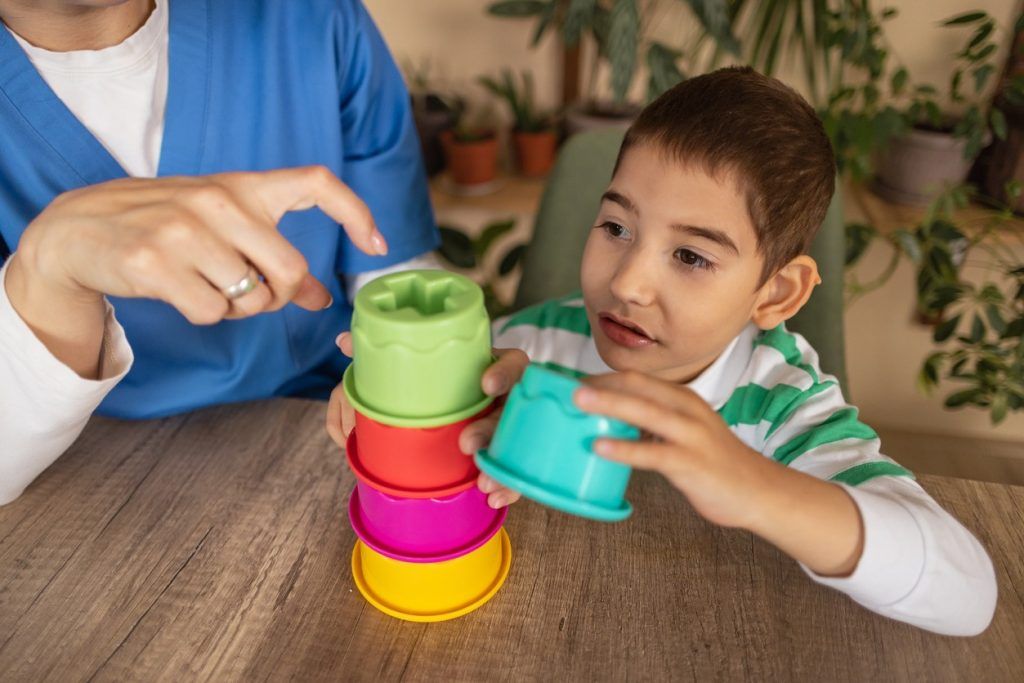
10 Ways OT Helps Children Thrive
Occupational therapy can help children with diagnoses like:
- Autism spectrum disorder
- Attention deficit hyperactivity disorder
- Chromosomal disorders like Down syndrome
- Musculoskeletal disorders
- And much more!
However, a child and their family can still seek services if they don’t have a diagnosis to work on various challenges, skills, or daily routines. This section will outline some examples of possible OT goals.
1. Fine Motor Skills & Gross Motor Skills
Fine motor skills involve the small, coordinated movements performed by the small muscles in the hands and wrists. These are required for tasks like:
- Handwriting
- Using utensils
- Using scissors
- Zipping a coat
Gross motor skills involve movement with the larger muscles of the body like the legs, arms, and torso. These skills are required for tasks like:
- Crawling
- Walking
- Climbing
- Throwing and catching
- Lifting
Developmental disorders can cause delays in the development of fine and gross motor skills. Occupational therapy can help a child build these skills and suggest modifications to activities in the meantime.
When working on fine and gross motor skills, occupational therapy sessions may involve:
- Games that rely on the use of fine or gross motor skills
- Exercises
- Practice using mobility devices
- Consultation on how to build skills at home
- Consultation on how to participate in activities of interest, regardless of current skill level
2. Bathing, Brushing Teeth & Other Self-Care
Self-care tasks are part of a child’s regular daily routine. For example:
- Getting clean
- Getting dressed
- Brushing teeth
- Brushing
Everyday tasks like those above can be difficult for a child and their caregivers if they experience challenges with:
- Fine motor skills
- Motivation
- Attention
- Sensory sensitivities
An occupational therapist can help:
- Identify the root cause of challenges
- Suggest necessary changes to routines
- Help your child practice the skills required to do these tasks independently
- Make recommendations for how to make the tasks more comfortable, easier, or pleasant
3. Toileting
Children may experience challenges with going to the bathroom or wiping. After a family rules out a medical complication with a physician, occupational therapists can help identify root causes, such as:
- Fear and anxiety
- Sensory sensitivities
- Motivation
Once the root cause is found, OTs provide recommendations to address it directly.
4. Eating
Eating a variety of foods is important for a child’s growth and development. This can be challenging for a child with IDD due to issues with:
- Tolerating different textures, smells, or tastes
- Anxiety
- Other medical conditions
Occupational therapists can help a child develop tolerance to different food types and educate caregivers on how to continue this practice at home.
5. Self-Regulation
Self-regulation, or emotional regulation, refers to a person’s ability to manage their own emotions, thoughts, and actions, especially in situations of discomfort or stress.
Some children with IDD experience challenges with:
- Transitions
- Changes in routine
- Navigating highly challenging social situations
OTs can help a child learn and practice self-regulation skills like:
- Using calming strategies
- Understanding negative emotions
- Managing negative thoughts
An occupational therapist can also coach caregivers on how to best navigate dysregulation and heightened emotions at home and at school.
6. Sensory Support
Children with IDD can have challenges with sensory processing. For example:
- They may be more or less sensitive to sensory input like bright lights, noise, or textures
- Their brain may have difficulty understanding sensory information
Occupational therapists can help:
- Identify challenges with sensory processing
- Safely practice interacting with different sensory input
- Make recommendations for accommodations or modifications to activities
7. School Success
OT can help if your child has challenges with:
- Completing schoolwork
- Time management and organization
- Feeling comfortable at school
- Accessing the school curriculum with their current abilities
An occupational therapist can help you and the school team:
- Identify challenges and suggest ways to create a more supportive environment
- Build the child’s confidence to advocate for themselves at school
- Build the skills necessary to complete schooling successfully
8. Focus, Attention & Executive Functioning
An occupational therapist can help your child build cognitive skills to complete the activities they need to do in their day.
Examples of skills an OT can help with are:
- Problem solving
- Planning
- Focus
9. Social Skills & Play
Developmental challenges can make it difficult to use social skills like:
- Picking up non-verbal cues from others
- Taking turns
- Managing conflict resolution
- Practicing assertiveness when needed
Occupational therapy sessions can help your child learn, understand, and use important social skills in a safe environment through social stories and play-based learning.
10. Mental Health
Occupational therapists who have received training can provide mental health support as part of their scope.
Children and young adults experiencing challenges with negative thinking, negative emotions, or low confidence and self-esteem can benefit from OT approaches like:
- Motivational interviewing
- Cognitive-behavioral principles
- Caching during therapy sessions

What To Expect During An OT Session
Pediatric occupational therapy can look different for every child and family depending on how they access OT services, where sessions happen, and the patient’s needs.
Consultative OT services are usually provided in schools, where an occupational therapist periodically visits a child to assess their needs and make recommendations for changes as needed.
Should you seek pediatric occupational therapy services for regular treatment, you can expect any of the following:
- Sessions on a schedule. For example, consistent weekly or bi-weekly sessions.
- One-on-one treatment with your child to work on the treatment goals.
- Treatment with a parent or caregiver present in the session.
- Play-based therapy that involves teaching skills through play, games, and movement.
- Therapy that involves tools or equipment. For example, swings, balance trainers, weighted equipment, or therapy putty.
- Collaboration with you as the caregiver.
- Regular caregiver consultation to monitor progress and discuss observations, goals, and recommendations.
As mentioned, occupational therapy can look different depending on your child’s needs. You should always discuss options for OT services with your occupational therapist before beginning sessions.
Supporting OT Goals At Home
As a caregiver, you play an important role in continuing to build skills learned in OT sessions at home.
You can support your child’s occupational therapy progress at home by:
- Asking for recommendations on following through with OT learning at home.
- Implementing recommendations given by your OT at home or at school.
- Communicating with your child’s OT about which recommendations are helping and which aren’t.
- Celebrating even small successes with your child at home as soon as you see them happen.
- Sharing insights learned with your child’s school team, other healthcare professionals they may be working with, and any of your child’s other caregivers.
When Is It Time For OT?
You now have a better understanding of occupational therapy and how it can benefit children.
If you’re still wondering if it’s time to explore OT, go through the following list of questions. If you answer “yes” to any of the questions, it may be time to search for OT services near you.
- Does my child experience challenges with their daily routine?
- Is there something in our day, I, or my child, wish could be easier, more pleasant, or more comfortable?
- Does my child experience frequent challenges doing tasks independently?
- Does my child appear distressed or uncomfortable during any regular daily activity?
- Am I concerned about my child’s safety (or mine) while they’re participating in any daily activity?
- Has their school team or healthcare team made a recommendation to explore occupational therapy services for any reason?
Looking for more resources on caring for children with IDD? Check if you have free access to Trualta.
References
- Cleveland Clinic. (2023). Fine motor skills.
- Cleveland Clinic. (2023b). Pediatric occupational therapy.
- Ontario Society of Occupational Therapists. (n.d.). Understanding OT.
- The College of Occupational Therapists of Ontario. (2023). Standard for psychotherapy.
- Riley, B. R., & de Sam Lazaro, S. L. (2021). Role of occupational therapy in pediatric primary care: Promoting childhood development. The American Journal of Occupational Therapy, 75(6), 7506090010.
- Cahill, S. M., & Beisbier, S. (2020). Occupational therapy practice guidelines for children and youth ages 5–21 years. The American Journal of Occupational Therapy, 74(4), 7404397010p1-7404397010p48.