Equipment For Stroke Patients At Home: A Guide
According to research, “every 40 seconds, someone in the US has a stroke, and every 4 minutes, someone dies from a stroke.” Strokes can leave devastating impairments for those who experience one. Different impairments exist depending on the part of the brain that is affected. No stroke is entirely the same.
Stroke impairment can range from:
- Weakness or paralysis on one side of their body.
- Balance impairments.
- Visual impairments, like having double vision or a blind spot.
- Difficulty speaking and swallowing
- Impairments in the ability to stand and walk.
While a key area of stroke treatment involves therapy from a professional, like a physical therapist or occupational therapist, another area of stroke care focuses on ensuring the home is equipped with important pieces of rehab equipment to allow the stroke survivor to be successful and safe in their environment. This is essential in helping stroke patients be more independent when completing daily activities and decreasing stress on caregivers. In this article, we’ll review different equipment that can help with stroke recovery.
To learn more about adaptive equipment and stroke rehabilitation, check if you have free access to Trualta’s learning library and community of caregivers.
Equipment For Every Room In The Home
Bathroom
Individuals use the bathroom to do daily tasks like showering, using the toilet, and brushing their teeth. These everyday tasks are personal and private, and having equipment that can make the stroke survivor more independent while keeping them safe and comfortable is key. We’ll explore important pieces of equipment and their use below:
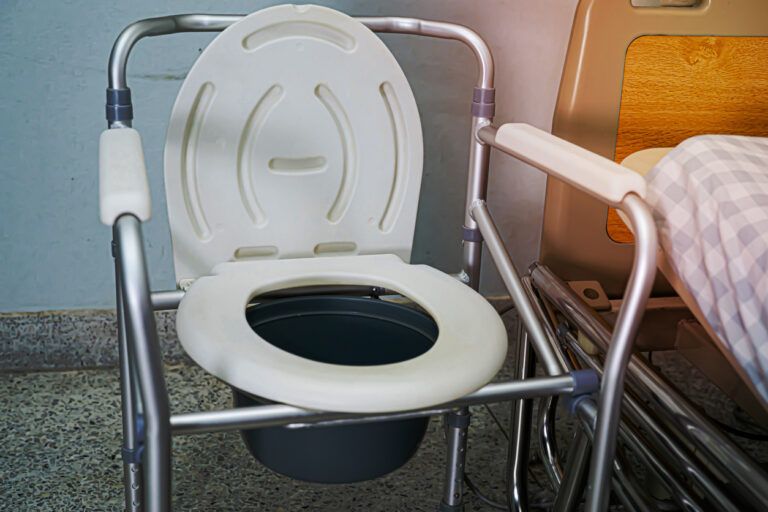
- Raised toilet seat or bedside commode. A raised toilet seat (or permanent commode) can be placed over the toilet to provide arm rests and an elevated seat height. This makes it easier to stand if someone has weakness.
- Grab bars are helpful because they provide a sturdy surface for people to hold on to when they stand up from the toilet or step into the shower.
- A foot scrubber mat is an easy, hands-free way for an individual to clean their feet during or after the shower without having to bend over and risk a fall.
- Shower chairs and tub benches are essential for individuals with weakness, decreased endurance, or balance problems. These pieces of equipment provide a place for individuals to sit down during their shower so they can wash their body without falling or getting too exhausted.
- A handheld shower head is helpful when someone is washing themselves because it allows them to get to hard-to-reach places while sitting on their shower chair or bench.
- A non-slip floor mat should be placed outside the shower to provide a safe place to step on when they’re exiting the shower to avoid any falls.
- A long-handled sponge is a helpful tool for washing and cleaning areas that are hard to reach, like the lower legs or back.

Kitchen
The kitchen is often the center of the household and a place where people gather to cook and enjoy food together. For individuals who have had strokes, tasks in the kitchen can pose a challenge (and sometimes a danger!).
Here are a few pieces of equipment that can help an individual with a stroke be more independent with their food preparation and eating tasks:
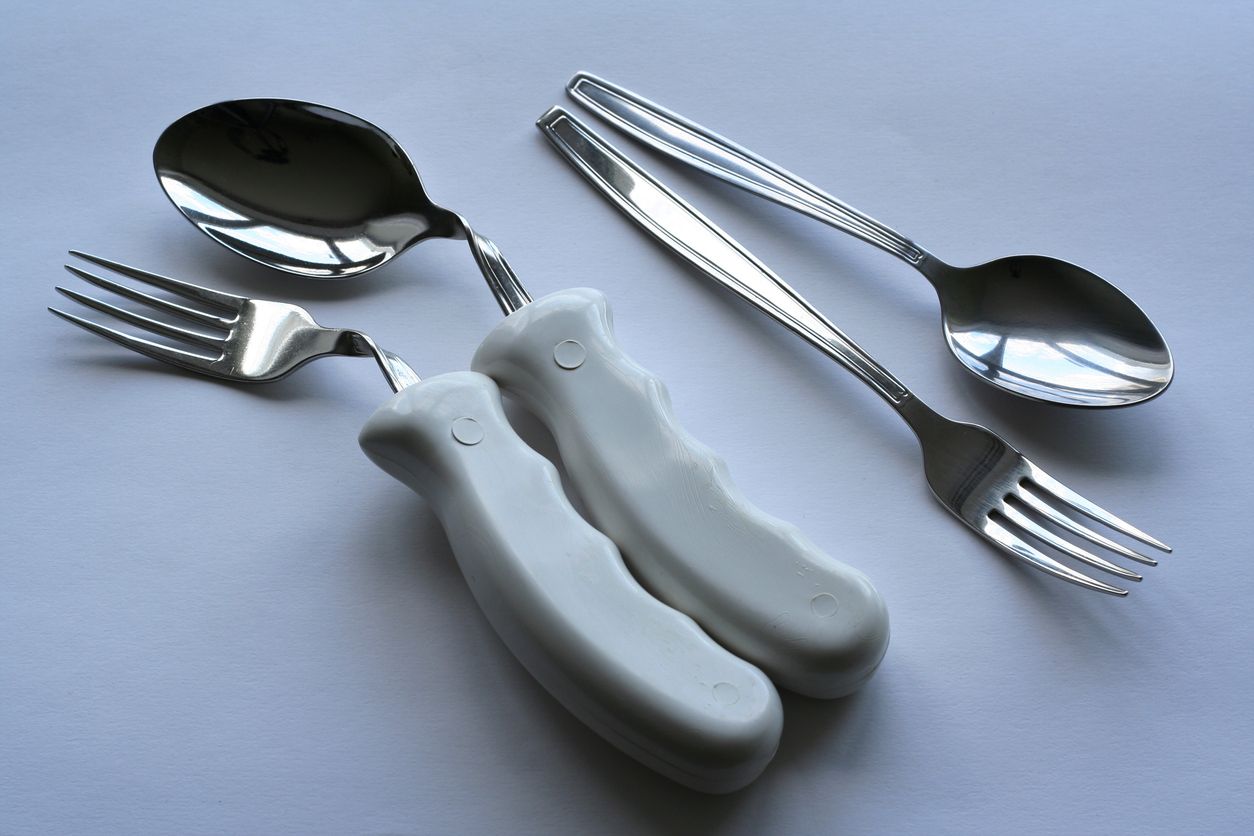
- Adapted utensils are forks, spoons, and knives with foam tubes in place to create built-up handles, making them easier to grasp if the stroke survivor has difficulty with fine motor skills.
- A universal cuff is a piece of fabric that slides around the palm of the user and has an open slot for a utensil to be positioned in it. This is helpful if grasp and grip strength is weakened and someone cannot hold a fork or knife but can move their arm.
- A rocker knife is an adaptive knife that has a “T-shaped” handle to take the complexity out of cutting. This type of knife is easier to grip and ergonomic friendly to allow a patient with a stroke to cut with improved ease.
- A non-slip cutting board is a kitchen essential that can be placed on countertops to avoid any slippage and to make cutting easier and safer for your loved one.
- Adaptive cups like the “Nose cup” pictured below can be helpful for individuals with limited head or neck mobility. The cup’s cutout allows the user to drink without having to move their head.

Living Room
Adaptive equipment used in the living room can include furniture and smart home devices, allowing the care recipient to have a comfortable place to relax, unwind, and enjoy restorative activities.
Here are some examples of adaptive equipment for the living room:
- Mobility aids. If the care recipient is walking, an assistive device like a walker, hemi-walker, or quad cane can help them safely navigate their home. Ask their physical therapist which device they recommend them to use for safety.
- Supportive chair with armrests. The easiest type of chair to stand from is one that does not rock, has armrests, and is not too low to the ground. Having a chair like this in the living room (with some cushions added for comfort) is helpful to provide a safe place for your loved one to rest, but also a place they can successfully stand up from.
- A remote control with large buttons is a helpful piece of equipment if your loved one’s vision is impaired. It allows the care recipient to operate and activate things like the television or lights (if remote control access is hooked up).
- A smart home device that is voice-operated and connected to the lights or television is a helpful tool that the stroke survivor can use to turn devices and lights on and off with ease. Additionally, a smart home device can be used to call family or a caregiver if a fall occurs or the care recipient needs help.

Conclusion
Adaptive equipment can reduce the stress, danger, and difficulty of many daily tasks for a stroke patient. There is a wide array of adaptive device options for stroke survivors that can keep them safe and help them be more independent during their stroke recovery. This can provide them with a greater sense of self-efficacy, which can boost their confidence and overall quality of life.
References
- Flint Rehabilitation. (n.d.). Adaptive equipment for stroke patients. Retrieved April 13, 2025, from https://www.flintrehab.com/adaptive-equipment-for-stroke-patients/?srsltid=AfmBOorfe3bWXAgBJfyhkHIWN1cZgzwrGEif5f4qMjmbTWoUwb5oc52U
- Saebo. (n.d.). Top adaptive kitchen aids for stroke recovery. Retrieved April 13, 2025, from https://www.saebo.com/blogs/advice/top-adaptive-kitchen-aids-for-stroke-recovery?srsltid=AfmBOory7Q9NvJIfAe0jAPw9SNK6Sg-7LX-jXKNDleucRs72r8W0gGme
- Stroke Association. (n.d.). Life after stroke: Equipment for independent living. Retrieved April 13, 2025, from https://www.stroke.org.uk/stroke/life-after/equipment-independent-living
- Stroke Association. (n.d.). Let’s talk about stroke: FAST. Retrieved April 13, 2025, from https://www.stroke.org/en/help-and-support/resource-library/lets-talk-about-stroke/fast#:~:text=Stroke%20is%20the%205th%20leading,someone%20dies%20from%20a%20stroke
- Stroke Rehab. (n.d.). Adaptive equipment for stroke rehabilitation. Retrieved April 13, 2025, from https://www.stroke-rehab.com/adaptive-equipment.html#gsc.tab=0