How To Communicate With Dementia Patients
Due to changes in cognitive abilities, communication and language challenges are common among people with dementia. They may have difficulties finding their words or understanding sentences. This can pose significant challenges for daily life, leading to:
- Frustration
- Lack of personalized care
- Conflict with their caregivers
This article will highlight 7 key strategies for dementia caregivers to facilitate better, more effective communication.
Want more information like this? Check if you have free access to Trualta.
7 Key Communication Strategies
1. Use Simple Messages
For a dementia patient, the following can be difficult to understand:
- Long sentences with too much detail
- Vague, abstract statements
Using short, simple sentences can make communication a lot easier. For example:
Instead of saying “I think it’ll get cold and rainy later and we won’t have time to come home and change. We should bring some extra layers with us,” Try “Let’s bring a sweater, too.”
A clear sentence can reduce confusion and allow your care recipient with dementia to focus on your message without feeling overwhelmed.
2. Focus On One Message At A Time
Due to changes in cognitive processes and cognitive decline, a dementia patient may struggle to understand more than one idea at a time. Care partners should remember to focus on one message or request at a time. This is one of the most effective communication techniques to reduce confusion and potential frustration.
Instead of saying “Go upstairs, get dressed and brush your teeth so we can go to the doctor’s.” all at once, break it down by communicating one thing at a time. Try “Let’s get dressed.” and waiting for them to respond and complete that task before moving on to the next.
As dementia progresses, you may need to break things down even further. A task like getting dressed involves multiple steps and a lot of processing for the brain. This can be difficult for someone with a dementia diagnosis. Break it down by guiding them through each step and waiting for them to complete a step before moving on. For example:
- “Let’s go upstairs,” followed by
- “Let’s pick a shirt.”
- “Let’s pick a pair of pants.”
- “Let’s take off your pajamas”
- And so on.
3. Give Them Time To Respond
A person with a dementia diagnosis may have trouble finding their words. It’s important to resist the urge to fill the silence after you’ve said something and are waiting for a reply.
You can count to 10 in your head. Doing so gives them time to process what you’ve said and a chance to create a verbal or non-verbal response (like nodding, pointing, or shaking their head).
This strategy can reduce frustration and even embarrassment for them, making it one of the most important communication skills to try.
4. Use Visuals
Verbal communication, otherwise known as speaking, is one of the most common ways to communicate. However, due to challenges with language, words might not be as simple to understand or speak for someone with dementia.
As a caregiver, you can use visuals to accompany or even replace your spoken word.
For example, instead of asking “Do you want an apple or an orange?” Try pulling both fruits out, one in each hand, and encourage them to point to which they’d prefer.
Other helpful visual aids include:
- Pictures
- Hand gestures
- Writing things down
5. Remember Non-Verbal Cues
Non-verbal cues make up more of our communication than we might think. This includes:
- Body language
- Tone
- Posture
- Facial expressions
- Gestures
Here’s how you can use non-verbal cues to your advantage:
- Speak in a calm, gentle voice. This can go a long way in improving comfort, trust, and willingness to move forward with a plan when necessary.
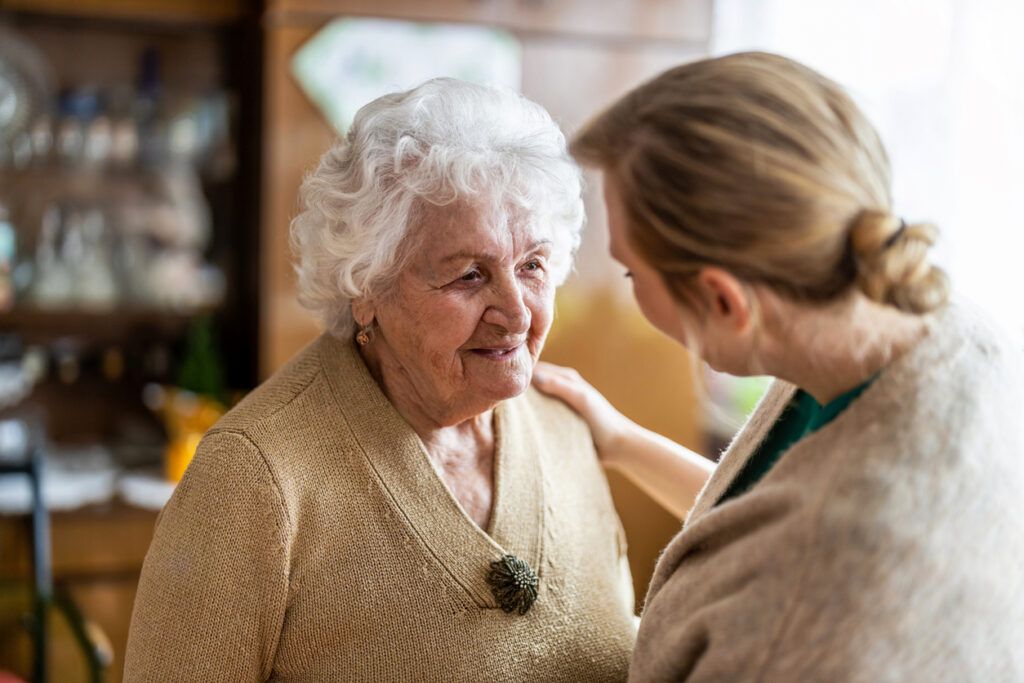
- Respect personal space by not standing too close, or consider when to place a gentle, comforting hand on a shoulder when appropriate.
- Smile, point, or a make a facial expression. This can make a big difference when a person with dementia is trying to interpret your message.
6. Reduce Distractions
Background noise, bright lights, or busy environments can make it harder for someone with dementia to focus on your message.
Use these tips to reduce distractions:
- Try to have conversations in a quiet, calm setting
- Turn off the television or radio
- Reduce movement around them
- Make sure they can see and hear you clearly
7. Avoid Arguing
It’s normal to want to correct someone when they’re confused, frustrated, or saying something that’s not entirely true. However, arguing, or even gently contradicting, can feel very distressing to a person with dementia.
As a caregiver, try to:
- Validate their feelings instead
- Calmly redirect the conversation
- Try using a distraction to shift their focus
For example, if they’re worried about getting to work on time, even though they’re retired, avoid trying to convince them they haven’t worked in years. Instead redirect their attention by saying something like “That sounds important! Let’s fold these clothes and get going.” Doing so can allow them to feel heard and avoid tension, while also helping them move on.
Conclusion
Caring for someone with dementia comes with practical and emotional challenges. Communication is one of the most complex challenges. If not handled well, it can lead to burnout.
You can foster the effective communication, improve dignity, connection, and reduce frustration and stress by remembering key tips:
- Use simple messages
- Focus on one idea at a time
- Give your care recipient with dementia time to respond
- Use visual aids to accompany your spoken word
- Use non-verbal cues
- Reduce distractions
- Avoid arguing
To find more information and resources on dementia care, check out Trualta and see if you have free access.
References
- Banovic, S., Zunic, L. J., & Sinanovic, O. (2018). Communication difficulties as a result of dementia. Materia socio-medica, 30(3), 221.
- NHS. (2023, August 16). Communicating with someone with dementia.
- Harvard Health Publishing. (2021, October 1). Bridging the gap: Dementia communication strategies.
- Better Health Channel. (n.d.). Dementia – communication.
- Alzheimer’s Society. (2023, June 30). Non-verbal communication and dementia.