
What Are The 4 Types of Dialysis?
Dialysis is life-saving for late stage kidney disease patients. Caregivers of kidney patients should be aware of the types of dialysis and how they work. You may need to help your loved one choose the best option.
In this article, we explain what dialysis is, describe the four types of dialysis, and list the pros and cons of each one.
Looking for more information about caring for someone with kidney disease? Check if you have free access to Trualta.
What Is Dialysis?
Dialysis is a treatment for late or end stage renal disease, also called kidney failure or kidney disease. In the later stages of the disease, the kidneys don’t function well. At stage 5, or end stage kidney disease, the kidney function is 15% or less. At this stage, kidney failure will be fatal without treatment.
Healthy and functional kidneys remove fluid and waste products from the blood. These are excreted in the urine. Dialysis is like an artificial kidney. It’s a treatment that removes fluid and waste when the kidneys cannot.
In addition to removing waste, dialysis helps maintain normal mineral levels in the blood, including potassium, sodium, and calcium. It also regulates blood pressure.
Many people need dialysis. Most dialysis patients have end stage chronic kidney disease. While dialysis care does not cure the disease, it can replace normal functioning while the patient waits for a kidney transplant. Some patients with an acute kidney injury can benefit from dialysis treatment while they heal.
Two Primary Types Of Dialysis
There are two main types of kidney dialysis:
1. Hemodialysis
Hemodialysis uses a dialysis machine to filter blood. It removes blood from the body, filters it through a dialyzer, and then returns cleaned blood to the body.
Before beginning dialysis, the patient undergoes a minor procedure to create access to a vein, typically in the arm. This is how blood circulates out of the body, through the machine, and back into the body.
Side effects or complications are possible with all types of dialysis. These include fatigue, itchy skin, and infections at the dialysis access site, in the skin, or even in the blood. Hemodialysis may cause additional side effects:
- Blockage at the hemodialysis access site
- Low blood pressure (hypotension)
- Muscle cramps
- Blood loss
- Dizziness
- Weakness
- Nausea
2. Peritoneal Dialysis
Peritoneal dialysis uses the patient’s own body to filter their blood. There is no dialysis machine. The filtering occurs in the abdominal cavity, where the peritoneum (lining of the abdomen) acts as the filter.
Peritoneal dialysis patients also require a minor procedure before treatment. The surgeon inserts a soft, flexible tube called a catheter into the abdomen. The peritoneal dialysis catheter is used to fill the abdomen with a filtering dialysis solution called dialysate.
As blood flows naturally to the abdomen, the dialysate pulls in waste and fluid. After a period of time, the dialysate, plus the extra dialysis fluid and waste products, drain back out of the body through the catheter.
In addition to the risk of infection, fatigue, and itchiness, peritoneal dialysis can lead to weight gain and an increased risk of a hernia. A hernia is possible because the treatment can weaken abdominal muscles.
Each of the two primary types of dialysis can be further split into two types, giving patients four total options for receiving kidney dialysis.
In-Center Hemodialysis
Hemodialysis can be done in a dialysis center or at home. In-center dialysis is mostly performed by staff at the center, although patients may do some of the process themselves. Most patients require three sessions per week, lasting three to five hours.
One of the most important benefits of in-center hemodialysis is that healthcare professionals are on hand to perform the procedure. Not all patients feel comfortable with or can do it themselves, even with a home caregiver assisting. Another potential benefit is that some patients enjoy the social aspect of being in a center with other patients.
There are also disadvantages of receiving hemodialysis at a center:
- In-center hemodialysis requires sticking to a strict schedule.
- Patients need reliable transportation to the dialysis center at least three times per week.
- Not everyone likes the social aspect of a dialysis center. Some prefer more privacy for treatment.
- Loved ones typically are not allowed to be with the patient during treatment.
Home Hemodialysis
Hemodialysis is also possible in the patient’s home. There are several benefits of receiving hemodialysis in the home as compared to in a center:
- Home hemodialysis patients undergo treatment more frequently, 5 to 7 times per week, which is associated with better outcomes.
- Many patients prefer to stay at home to receive care. This is especially beneficial for patients without access to transportation.
- The home schedule for dialysis is at the discretion of the patient and caregivers. It’s more flexible than in-center treatment.
- The flexibility and ability to perform dialysis at home give many patients a greater feeling of control and independence.
Of course, there are also disadvantages to home hemodialysis:
- The patient cannot do home hemodialysis alone. They must have a dialysis partner present.
- Patients and their partners in dialysis must attend training prior to beginning in-home hemodialysis.
- Patients must keep a dialysis machine at home as well as the required supplies. Special plumbing or electricity may be needed.
- Some patients and caregivers are uncomfortable doing dialysis without trained healthcare providers on hand.
Continuous Ambulatory Peritoneal Dialysis (CAPD)
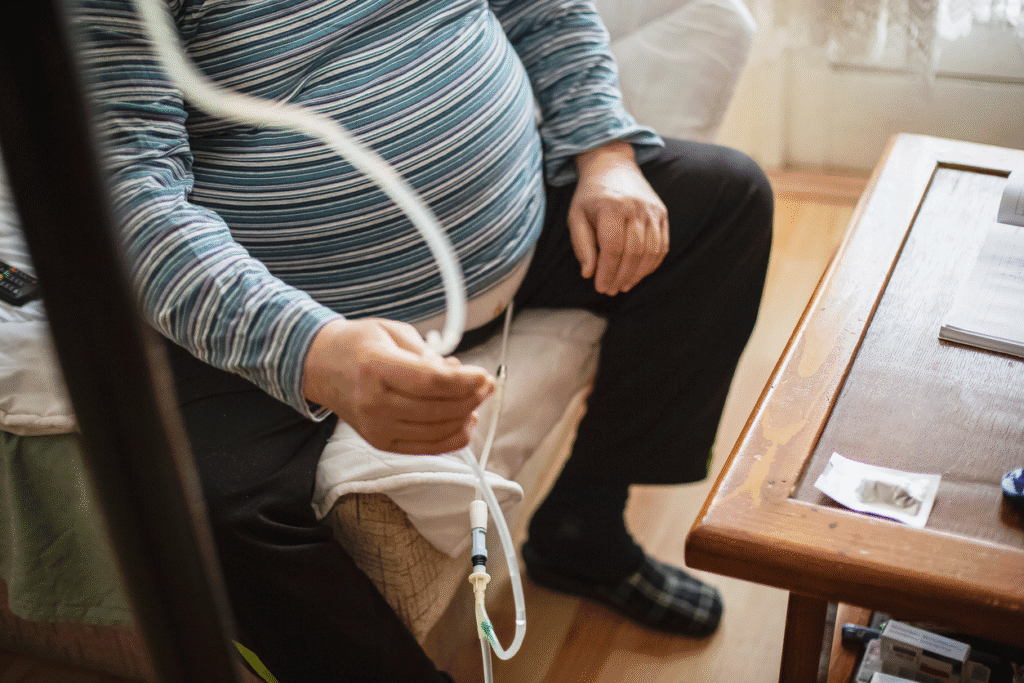
There are two types of peritoneal dialysis, both of which are done at home. CAPD does not require a machine. It uses a bag of dialysate fluid held above the patient’s shoulder to allow gravity to pull it down into the patient’s abdomen through the catheter. The solution with waste products is then drained out of the abdomen through the catheter.
Filling the abdomen takes about 30 minutes. The entire process must be repeated three to five times per day. There are some important benefits of doing dialysis this way, as compared to hemodialysis:
- Peritoneal dialysis filters the blood more frequently, which reduces stress on the heart.
- Peritoneal dialysis acts more like a real kidney than hemodialysis. Patients generally experience more well-being on this type of dialysis. They require fewer medications and have fewer dietary restrictions.
- Although they need the procedure more frequently, patients on CAPD have more flexibility and are more mobile. They can travel with their supplies and do the procedure from any location.
- This type doesn’t require dialysis access sites at blood vessels, which preserves them for future use of hemodialysis if it becomes necessary.
The disadvantages of peritoneal dialysis and CAPD in particular include:
- Daily, frequent sessions
- Potential for weight gain due to glucose in the dialysate solution
- Difficulty managing blood sugar if the patient has diabetes
- Limited bathing or swimming due to catheter placement
- Potential for infection at the catheter site
- Need for in-home storage of supplies
Automated Peritoneal Dialysis (APD)
Automated, or continuous cycling peritoneal dialysis, uses a machine to perform peritoneal dialysis. Most patients do it while asleep at night, but it can also be done as shorter sessions during the day, as with CAPD.
The benefits of APD are similar to those of CAPD: better overall health, fewer restrictions, and a more flexible schedule. Unlike CAPD, it does require a machine in the home, so travel isn’t as easy.
At one time, infections were less common in APD than CAPD, but improvements to the latter have reduced infection rates. According to studies, there are still some health advantages to APD:
- Greater flexibility in prescription dialysate
- Fewer pressure-related complications
- Less stress on the peritoneum
- Remote monitoring possible
On the other hand, these studies also show that APD does not clear sodium and phosphate as well as CAPD.
Is Hemodialysis Or Peritoneal Dialysis Better?
Ultimately, the choice depends on the individual patient. If you care for someone with kidney failure, discuss the options with them and their medical team, even before they need dialysis.
Any type of home dialysis might seem like the obvious choice, but it’s not for everyone. Carefully weigh the pros and cons of each type. Your care recipient’s medical team will be able to help you decide which option is best. And, remember that the patient can always change dialysis types if they choose. Their doctors should monitor their progress and adjust care as needed.
Don’t forget to check if you have free access to Trualta for more caregiving resources and support groups.
References
- Cleveland Clinic. (2025). Dialysis.
- National Kidney Foundation. (2023). Dialysis.
- National Kidney Foundation. (n.d.). Peritoneal dialysis.
- Domenici, A., & Giuliani, A. (2021). Automated peritoneal dialysis: patient perspectives and outcomes. International Journal of Nephrology and Renovascular Disease, 385-392.